Ideas
Industry Media
Supreme Court and FCC Decisions Shift the Leverage in TV Ownership and Carriage
Nexstar’s retransmission fight continues as regulators loosen ownership limits and narrow a station’s satellite must-carry rights.
The Supreme Court kept DirecTV’s antitrust case against Nexstar alive while FCC decisions changed national station ownership, satellite must-carry and license-transfer rules.
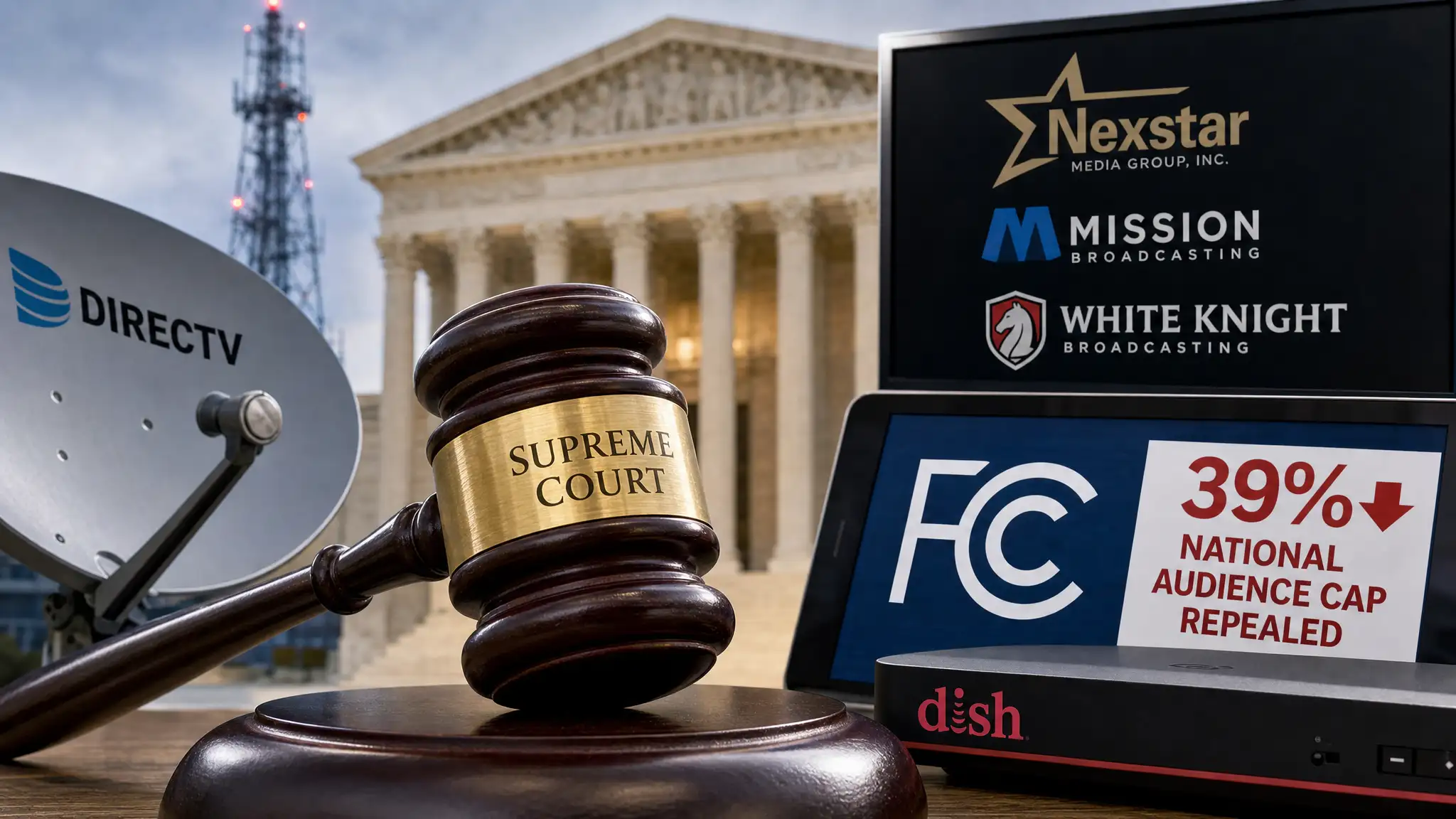
The U.S. Supreme Court on October 5 rejected Nexstar Media Group’s request to review a ruling that revived DirecTV’s antitrust lawsuit over retransmission-consent negotiations. The justices gave no explanation, leaving Nexstar, Mission Broadcasting and White Knight Broadcasting to face DirecTV’s claims in lower court.
DirecTV sued in 2023, alleging that Nexstar colluded with Mission and White Knight to fix retransmission prices in markets where Nexstar and one of the other broadcasters each controlled a Big Four network affiliate. DirecTV said Mission and White Knight used a negotiator who acted as Nexstar’s agent, shared confidential rates and financial information, and coordinated channel blackouts and public messaging. The satellite provider said the resulting outages affected approximately 1 million customers.
A federal district court dismissed the case in 2024. The U.S. Court of Appeals for the Second Circuit reversed that result in December 2025, finding that DirecTV had antitrust standing and could pursue its claims. Nexstar argued that the appellate decision conflicted with other federal rulings and improperly expanded potential price-fixing liability. The Supreme Court’s refusal to intervene does not resolve DirecTV’s allegations, but it preserves a case that could influence how station groups use shared-service relationships and negotiate carriage fees.
The decision followed several FCC actions that also changed broadcasters’ business options. The commission formally released its order eliminating the rule that limited a television-station owner’s national audience reach to 39%. Chairman Brendan Carr and Commissioner Olivia Trusty supported replacing the cap with case-by-case transaction reviews. Commissioner Anna M. Gómez dissented, arguing that Congress established the limit and only Congress can remove it. The repeal potentially gives Nexstar, Sinclair and other station groups more room to pursue acquisitions, although future deals still face FCC review and possible litigation.
In a separate carriage case, the full FCC sided with EchoStar’s Dish Network and reversed its Media Bureau’s ruling involving CNZ Communications’ WHOT-TV. Although WHOT is licensed to Opelika, Alabama, in the Columbus market, Nielsen assigns it to Atlanta. The FCC ruled that WHOT can claim satellite must-carry rights in Atlanta, but not additionally in its community of license.
The FCC also approved Howard Stirk Holdings’ $3.25 million transfer of stations to Sinclair, including MeTV affiliate WGWG-TV in Charleston, South Carolina. Together, the decisions alter the negotiating, acquisition and distribution rules governing how local stations reach antenna, cable and satellite viewers.
Footnotes
Articles used to create this Fact Brief
- SCOTUS Denies Nexstar’s DirecTV Retrans AppealRadio + Television Business Report
- Supreme Court Rejects Nexstar Bid to End DirecTV DisputeTV Technology
- FCC formalizes elimination of broadcast ownership capThe Desk
- In Dissent, Gómez Again Calls TV Ownership Rule Deletion ‘Unlawful’Radio + Television Business Report
- FCC Formally Erases Congressionally-Mandated National TV Reach CapRadio + Television Business Report
- FCC issues rare reversal of Media Bureau decision in must-carry caseThe Desk
- FCC approves Stirk TV license transfers to SinclairThe Desk
Continue reading