Ideas
IdeasIndustry Media
Broadcasters Pull Spectrum in Two Directions as NextGen TV Economics Take Shape
Station operators are seeking stronger OTA reception while pitching ATSC 3.0 as a route to consumer engagement and new revenue.
RNN retreats from a Boston-area UHF move as Georgia Public Broadcasting seeks one in Savannah, while Sinclair and Nexstar promote NextGen TV and Sinclair outlines a multibillion-dollar spectrum opportunity.
Two FCC channel proceedings reported September 22 show broadcasters still trying to improve basic over-the-air reception even as major station groups promote NextGen TV and calculate how ATSC 3.0 could free spectrum for new businesses.
In Massachusetts, RNN Boston License Co. abandoned an approved plan to move full-power WWDP in Norwell from VHF channel 10 to UHF channel 36. RNN had argued that WWDP and channel-sharing partner WMFP in Foxborough received complaints about unreliable VHF reception. The FCC approved the substitution in January 2023, but RNN later said it could not complete the move promptly and asked to retain channel 10. The FCC has now allowed the reversal, preserving WWDP’s current operation rather than leaving the station waiting for an impractical upgrade.
Georgia Public Broadcasting is moving in the opposite direction. The FCC opened a rulemaking and comment period on GPB’s request to shift PBS member station WVAN-TV, serving Savannah and Pembroke, from VHF to a more powerful UHF facility. WVAN carries GPB, GPB Create, GPB Knowledge and GPB Kids for antenna households. The proceeding gives affected parties an opportunity to address whether the proposed UHF operation would improve service and satisfy FCC technical requirements.
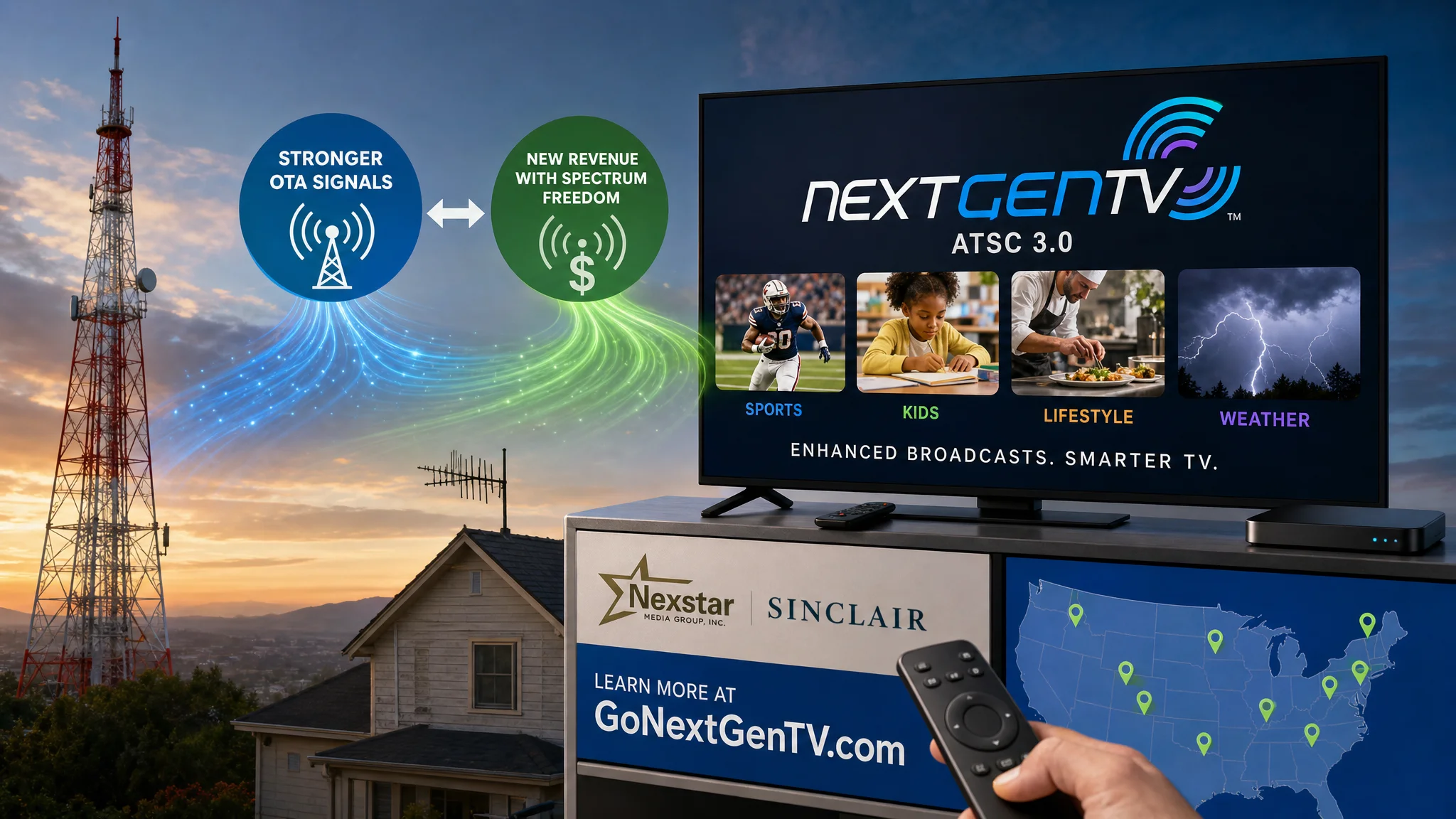
These reception-focused cases arrived days after Sinclair and Nexstar Media Group began a joint consumer campaign for NextGen TV, the consumer brand for ATSC 3.0. Starting September 17, on-air and social promotions were scheduled across 13 markets: Nexstar’s Cleveland, Austin, Kansas City, Tampa, Portland, Buffalo and Denver markets, and Sinclair’s Las Vegas, Columbus, Nashville, Baltimore, Seattle and Washington markets. GoNextGenTV.com provides ZIP-code availability searches and guidance on compatible television sets, converter boxes, antennas and cables. Sinclair technology president Del Parks said a Columbus test showed that education could increase engagement, while Nexstar technology and digital chief Brett Jenkins predicted informed consumers would seek ATSC 3.0-capable televisions.
Sinclair CEO Chris Ripley has also framed NextGen TV as a spectrum-efficiency play. He estimated Sinclair could run its core television service on 20% to 25% of its present capacity and said its spectrum portfolio could represent more than $4 billion in value if excess capacity can be leased or sold to wireless or satellite users.
ConsumerEXP analysis: Viewers could gain stronger signals and enhanced broadcasts, but broadcasters’ larger payoff depends on FCC transition policy, compatible receivers and proven demand for both NextGen TV and repurposed spectrum.
Footnotes
Articles used to create this Fact Brief
- In Suburban Boston, A VHF-to-UHF Move Is NixedRadio + Television Business Report
- GPB Seeks VHF-to-UHF Upgrade In SavannahRadio + Television Business Report
- Sinclair, Nexstar Launch Campaign to Raise Awareness of NextGen TVTV Technology
- Sinclair CEO: Monetizing spectrum is $4 billion opportunity for broadcastersThe Desk
Continue reading