Ideas
IdeasIndustry Media
Hispanic Streaming Growth Exposes TV’s New Reach and Data Challenge
Nielsen’s viewing totals show a valuable multiplatform audience as broadband alternatives and weaker referral traffic complicate direct access.
Hispanic viewers generated more than 2 trillion TV minutes in early 2026, but fragmented platforms, broadband alternatives and changing discovery are forcing media companies to rethink reach and first-party audience strategies.
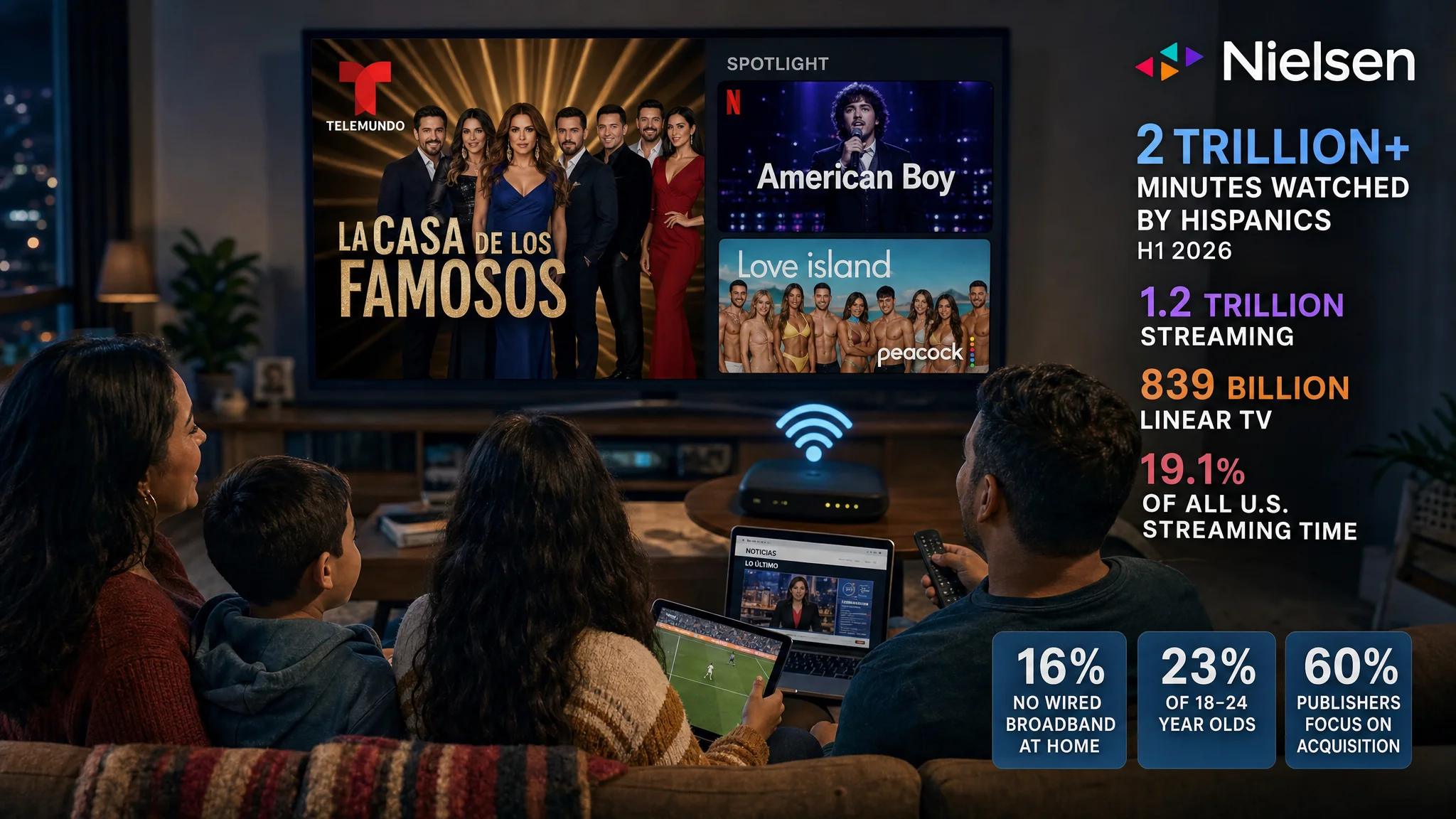
Nielsen reported on September 23 that Hispanic audiences watched more than 2 trillion minutes of television during the first half of 2026, demonstrating substantial reach across streaming and linear TV rather than a wholesale migration to one platform. Nielsen’s 2026 Hispanic Diverse Intelligence Series attributed 1.2 trillion minutes to streaming and 839 billion to linear television. Hispanic viewers generated 19.1% of all U.S. streaming time—nearly one of every five minutes.
The audience divides sharply by age, device and language. Connected devices accounted for 88% of TV time among Hispanic children ages 2 to 11, while 61% of Hispanic adults ages 18 to 34 paid for ad-free streaming. Hispanic adults 65 and older averaged nearly 45 hours of television weekly, predominantly through linear channels. Spanish-language programming captured 42% of Hispanic linear viewing despite English-language programming outnumbering Spanish content nine to one.
Individual programs illustrate the commercial opportunity. Telemundo’s “La Casa de los Famosos” attracted as many as 1.6 million Hispanic viewers nightly. Young Hispanic viewers represented nearly 13% of Peacock’s “Love Island” audience across 12.6 billion streamed minutes. Marcello Hernández’s Netflix special “American Boy” reached 7.4 million viewers and generated 486 million minutes; 68% of its audience came from outside the Hispanic community. Stacie deArmas, Nielsen’s head of cultural content and insights, characterized Hispanic viewers as a growth engine spanning platforms, languages and generations.
Reaching that audience, however, increasingly depends on infrastructure and direct customer relationships. S&P Global Market Intelligence Kagan’s first-quarter 2026 MediaCensus survey found that 16% of respondents lacked traditional wired home broadband, instead using fixed wireless, satellite or mobile data—or having no home internet. The rate reached 23% among 18- to 24-year-olds. Rural limitations drove 43% of satellite subscribers away from wired service, while 37% of fixed-wireless users cited mobile-plan bundles.
Separately, an August survey of 90 publishers by Digiday and Braze found that 60% prioritized subscriber acquisition and 40% prioritized retention as AI search reduced predictable referral traffic. Their responses emphasized registration, newsletters, exclusive content, personalization and first-party data.
ConsumerEXP analysis: For programmers, broadcasters, streaming services, advertisers and distributors, the Nielsen totals reveal a large audience whose value cannot be captured through a single channel. Winning it requires culturally relevant programming, measurement across linear and connected TV, adaptable broadband distribution and direct, permission-based audience relationships.
Footnotes
Articles used to create this Fact Brief
Continue reading