Ideas
Industry Media
Comscore’s Ad-Exposure Metric Reveals CTV’s Next Competitive Fault Line
YouTube’s commanding share sharpens industry pressure to improve targeting signals, prove incremental sales and widen access to premium inventory.
Comscore’s new ad-exposure measurement puts YouTube far ahead of rival streamers while highlighting unresolved CTV challenges involving signals, attribution and premium-inventory access.
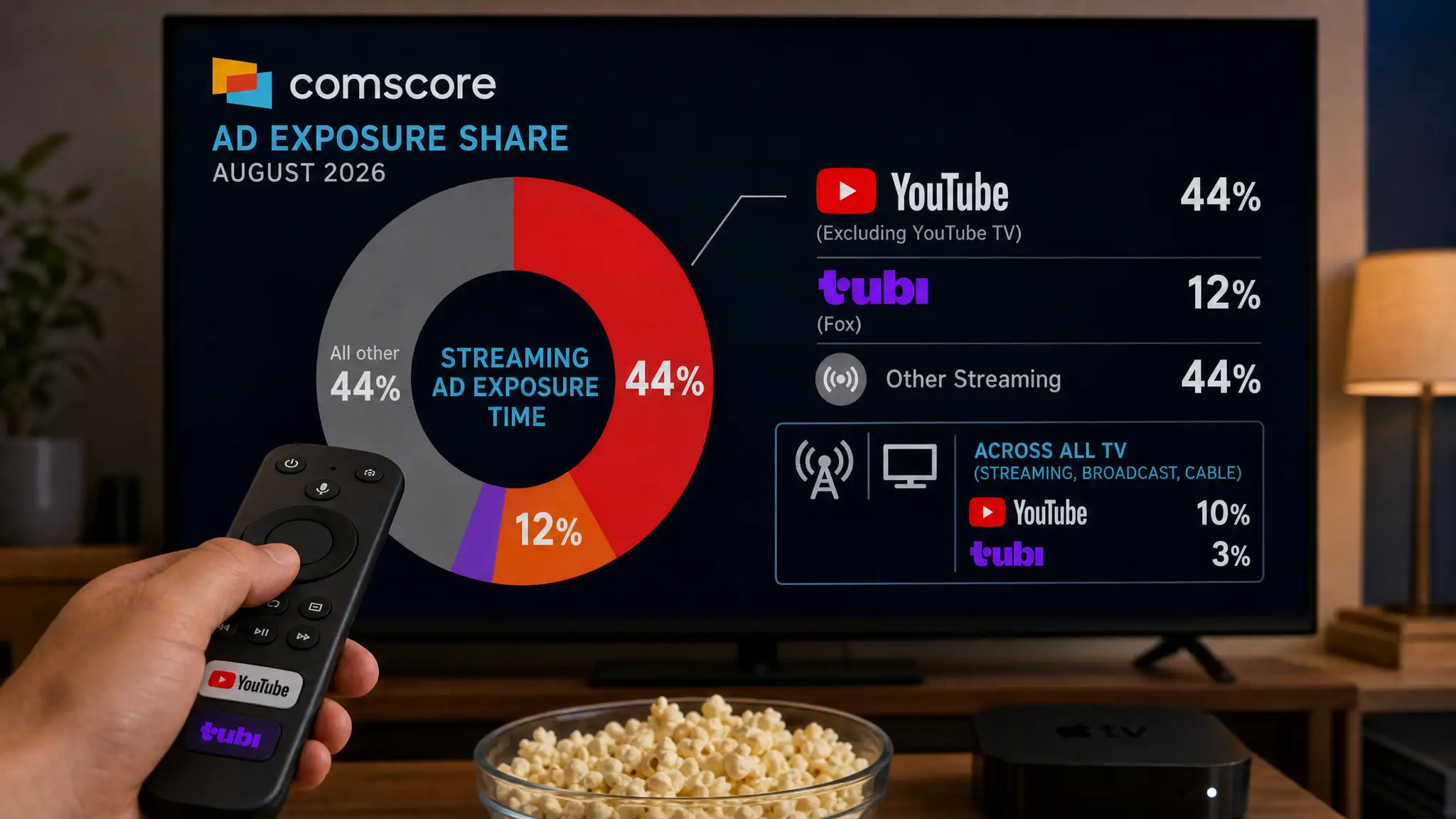
Comscore’s new The Score Report is giving television advertisers a different way to evaluate the market: by measuring the time audiences are exposed to commercials rather than total viewing alone. Digiday reported October 21 that YouTube, excluding YouTube TV, captured 44% of streaming ad-exposure time in August 2026 and about 10% across streaming, broadcast and cable combined. Fox-owned Tubi ranked second with 12% of streaming exposure and roughly 3% of the cross-TV total. (digiday.com)
Comscore combines viewing time and advertising loads using its Comscore TV measurement currency and automatic content recognition technology. Kevin Burns, Comscore’s chief of staff and interim chief revenue officer, said the company totals advertising minutes experienced during a broadcast month and calculates shares for channels, platforms and local markets. Streaming’s overall share rose from 16% a year earlier to 21% after NBCUniversal’s February combination of the Super Bowl, Winter Olympics and NBA All-Star Game, but it continued to trail traditional television in commercial exposure. (digiday.com)
The report makes ad exposure a new competitive benchmark, but related industry commentary shows why exposure alone cannot settle CTV’s value. Amit Nigam, PebblePost’s senior vice president of product, argued that marketers can mistakenly credit CTV for purchases that email, paid search and other channels also claim. He recommended establishing exposed and control groups before campaigns begin, incorporating online and physical-store transactions, and using verified commerce signals to identify households likely to convert. (streamingmedia.com)
Signal quality is another constraint. In a Wurl-sponsored AdExchanger article, Vice President of Global Advertising Ria Madrid said broad program labels do not describe the specific imagery, dialogue, emotion and other context surrounding an ad break. She argued that AI can generate richer scene-level intelligence, but inconsistent metadata and separate integrations prevent advertisers from activating those signals uniformly across streaming inventory. (adexchanger.com)
Access remains uneven as well. Chief Media President Vic Golio wrote that premium ad-supported services still favor direct sales, minimum commitments and workflows that smaller performance advertisers and lean agencies may struggle to manage. He proposed third-party self-service access points combining inventory, rates and buying tools. (streamingmedia.com)
ConsumerEXP analysis: Comscore’s metric clarifies where commercial attention accumulates, but the next CTV winners will also need interoperable signals, credible incrementality testing and purchasing systems that extend premium inventory beyond the largest buyers.
Footnotes
Articles used to create this Fact Brief
Continue reading